<aside> 💡 Question 1
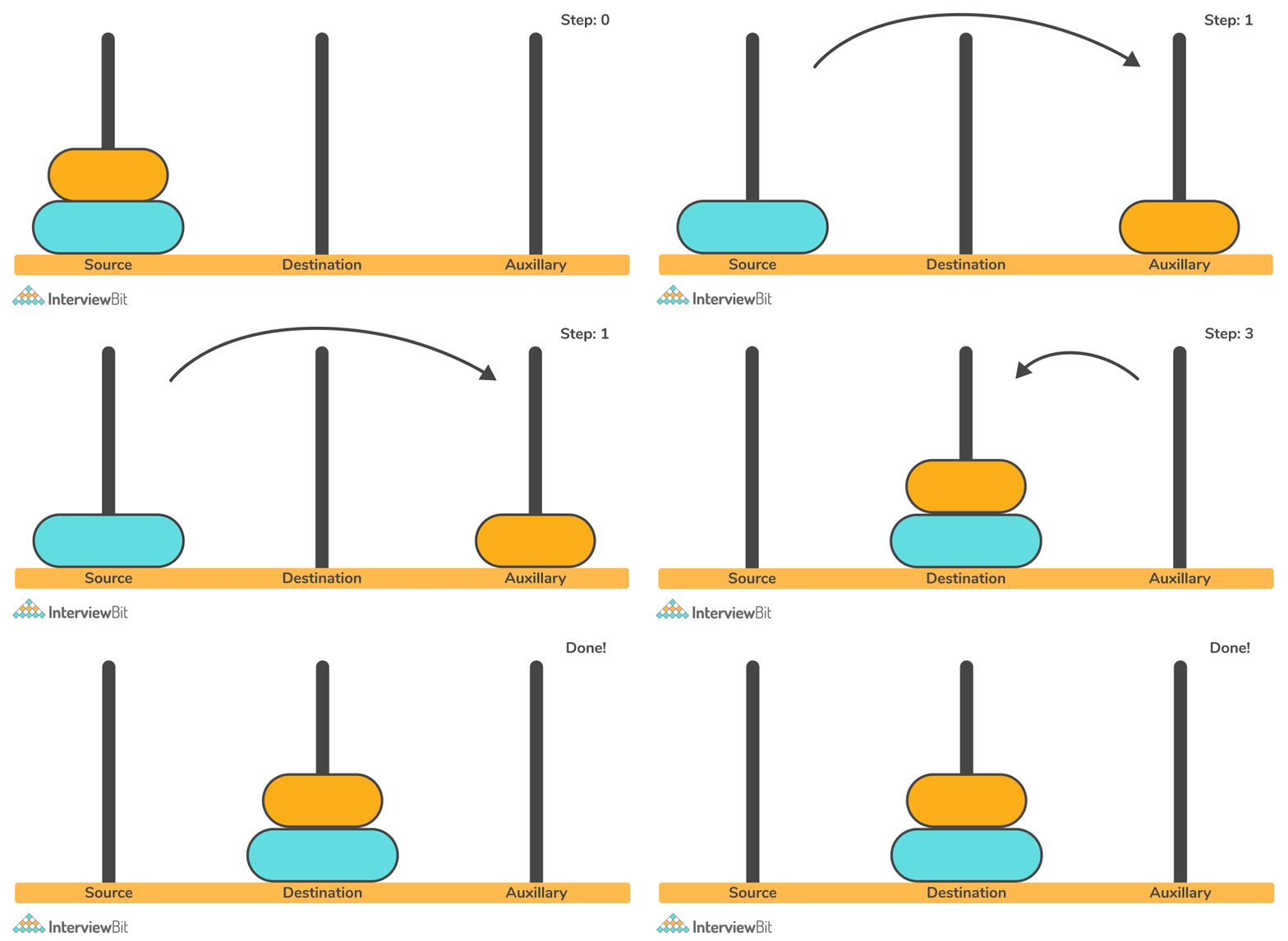
Discuss Towers of Hanoi puzzle.
Solution: The Towers of Hanoi is a mathematical puzzle.
def toh(n,source,auxiliary,destination):
    if n==0:
        return
    toh(n - 1, source, destination, auxiliary)
    print("Move disk %d from peg %d to peg %d" % (n, source, destination))
    toh(n - 1, auxiliary, source, destination)

def towerOfHanoi(n):
    # Write your code here
    # Return a 2-D array
    toh(n,1,2,3)
https://whimsical.com/recursion-K1nZYz3VMFpSRcjW22H9uE
</aside>
<aside> 💡 Question 2
Family Structure
Problem Statement: Aakash is a member of Ninja club. He has a weird family structure. Every male member (M) gives birth to a male child first and then a female child, whereas every female (F) member gives birth to a female child first and then to a male child. Aakash analyses this pattern and wants to know what will be the Kth child in his Nth generation. Can you help him?
Example:
<aside> 💡 n=2 k=2 n=3 k=4
Output will be:
Solution:

def kthChildNthGeneration(n, k):
    # if the its 1st gen or  1st child we know it,s akash i.e Male
    if n == 1 or k == 1:
        return "Male"

    # Now determine the parent of k (not the gender just the number)

    parent = (k + 1) // 2

    # now we determine the parent gender
    # we will call recursion to do it for us
    # to check parent gender we will go back in genrations hence n - 1
    # this was the reason we dtermined the prents number(which child ore prev gen he was)
    # which will be our new k

    parent_gender = kthChildNthGeneration(n-1, parent)

    #after determining parent gender we will see if the given child is the first child
    # if yes then we will print the parent gender
    # now to do that we did (k + 1) // 2 to get the parent
    # reversing that step will give the number of 1st child of that parent
    # if that number is equal to k we return the parents gender

    if k == (2*parent) -1:
        return parent_gender

    else:
        # if not then it's the second child
        #we check parents gender and
        #return opposite gender
        if parent_gender == "Male":
            return "Female"
        else:
            return "Male"
</aside>
<aside> 💡 Question 3
Given an integer n, return *true if it is a power of three. Otherwise, return false*.
An integer n is a power of three, if there exists an integer x such that n == 3x.
Example 1:
Input: n = 27
Output: true
Explanation: 27 = 33
Example 2:
Input: n = 0
Output: false
Explanation: There is no x where 3x = 0.
To determine if a given value is a power of 3, you can use the following problem-solving approach:
Let's go through an example using the value 81:
Since the final result is 1, we can conclude that 81 is a power of 3.
Let's try another example with the value 64:
By following this process, you can determine whether a given value is a power of 3 or not, without the need for writing a program.
def Power_of_three(n):
    if n==1:
        return True
    if n<1 or n%3 !=0:
        return False

    return Power_of_three(n/3)
</aside>
<aside> 💡 Question 4
Given an integer n, return *true if it is a power of two. Otherwise, return false*.
An integer n is a power of two, if there exists an integer x such that n == 2x.
Example 1: Input: n = 1
Output: true
Example 2: Input: n = 16
Output: true
Example 3: Input: n = 3
Output: false
To check if a value is a power of 2 using problem-solving, you can use the following approach:
Let's go through an example using the value 16:
Since the final result is 1, we can conclude that 16 is a power of 2.
Let's try another example with the value 15:
By following this process, you can determine whether a given value is a power of 2 or not, without the need for writing a program.
def Power_of_two(n):
    if n==1:
        return True
    if n<1 or n%2 !=0:
        return False

    return Power_of_two(n/2)
</aside>
<aside> 💡 Question 5
Given a number n, find the sum of the first natural numbers.
Example 1:
Input: n = 3
Output: 6
Example 2:
Input : 5
Output : 15
Note:
Algorithm:
Make sure to test your solution with different test cases to ensure its correctness and efficiency.
To find the sum of the first n natural numbers using recursion, you can follow this problem-solving approach:
Here's an example of a recursive function to find the sum of the first n natural numbers:
def sum_of_naturals(n):
    if n == 0:
        return 0
    return n + sum_of_naturals(n-1)
</aside>
<aside> 💡 Question 6
</aside>
<aside> 💡 Question 7
</aside>
<aside> 💡 Question 7
</aside>
<aside> 💡 Question 8
</aside>